
India has moved up 16 positions to rank 55th on a global index of the world's most competitive economies, where Switzerland remains on top.

India's economy is forecast to grow at 4.8 per cent in 2013, down 1.3 per cent from its earlier projection, the UN's World Economic Situation and Prospects 2014 report said.

Shares of real estate firms have been outperforming over the past year. The rally, analysts say, may hit roadblocks in the near term amid stretched valuations, even as the long-term prospects for the sector remain ebullient. "Most of the positive news flow is already in the price. Hence, investors sitting on hefty profits may partially cash out at current levels," suggests V K Vijayakumar, chief investment strategist at Geojit Financial Services.

India's manufacturing sector activities moderated in March with companies reporting softer expansions in new orders and production as inflation concerns dampened business confidence, a monthly survey said on Monday. The seasonally-adjusted S&P Global India Manufacturing Purchasing Managers' Index (PMI) was at 54.0 in March, down from 54.9 in February, highlighting weakest rate of growth in terms of production and sales since September 2021. The March PMI data pointed to an improvement in overall operating conditions for the ninth straight month.

Monetary Policy- Easing expected to happen later this financial year.

However, the growth during the next financial year would be higher at 8.1 per cent in case of a second wave of the coronavirus and bit slower at 7.9 per cent if the virus recedes and remains under control.

The phone conversation came days after it emerged that Modi will not be travelling to Russia for the annual India-Russia summit this year.

BSE Bankex, Healthcare, Capital Goods and Consumer Durables ended higher.

'In India foreign policy is generally handled by the prime minister.' 'One can clearly see the Vajpayee stamp on all this.' 'Only a person with poetic imagination can weave such a complex web,' says Colonel Anil A Athale (retd).
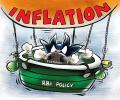
The Reserve Bank of India on Friday raised the retail inflation target for the current financial year to 5.7 per cent on the back of rising global prices amidst the ongoing geo-political tensions, even as it expected the prices of cereals and pulses to soften on prospects of good winter crop harvest. "Global food prices along with metal prices have hardened significantly. "Economy is grappling with a sharp rise in inflation... Inflation is now projected at 5.7 per cent in 2022-23 with Q1 at 6.3 per cent; Q2 at 5 per cent; Q3 at 5.4 per cent and Q4 at 5.1 per cent," RBI Governor Shaktikanta Das said while unveiling the first monetary policy review for the current fiscal year.

ICICI Bank was the top gainer in the Sensex pack, surging 4.64 per cent, followed by Axis Bank at 3.86 per cent and SBI 2.53 per cent.

Market breadth continued to remain strong, with 1899 gainers and 674 losers on the BSEs.

The laggards in the Sensex kitty were Vedanta, Tata Steel, M&M, HCL Tech, Bharti Airtel, Maruti Suzuki, L&T, Asian Paint and HDFC

On the volume side, the number of M&A and PE deals was 110 in July, 15 per cent lower from 130 in July 2018.

India is increasingly a willing participant in the evolving US' Indo-Pacific strategy. While these developments are related to the perception of a growing Chinese security challenge, their implications for India's much-vaunted strategic autonomy should be a matter of deeper and closer reflection, asserts former foreign secretary Shyam Saran.

Zudio was the standout performer as it tapped into the pentup demand in small-town India, at a pace never seen before, notes Indrajit Gupta, co-founder and director, Founding Fuel.

India's projected GDP in 2030 was $10,133 bn, behind America's $32,996 bn and China at the top with a projected GDP of $34,338 bn

IMF, which has also lowered its global economic growth forecast for 2016 and 2017 by a marginal 0.1 per cent to 3.1 and 3.4 per cent respectively, recommended six 'reform priorities' for India

Expenditure on new projects slowed down for the second quarter in a row amid an uncertain global environment and higher borrowing costs. There were new projects worth a cumulative Rs 3.26 trillion in the July-September period, according to data provided by project tracker Centre for Monitoring Indian Economy (CMIE). This figure is much less than Rs 4.39 trillion in the June quarter (Q1FY23) and Rs 8.46 trillion in the March quarter (Q4FY22).

The Indian services sector activity fell to a six-month low in September, as new business inflows rose at the slowest rates since March, amid inflationary pressures and competitive conditions, a monthly survey said. The seasonally adjusted S&P Global India Services PMI Business Activity Index fell to 54.3 in September, from 57.2 in August, highlighting the weakest rate of expansion since March. For the fourteenth straight month, the services sector witnessed an expansion in output. In Purchasing Managers' Index (PMI) parlance, a print above 50 means expansion, while a score below 50 denotes contraction.

A report stated that despite initial setbacks from demonetisation and Goods and Services Tax, "all in all" the Indian economy has done well.

For 2015-16, IMF pegged India's growth rate at 7.5 per cent.

A rise in petrol and diesel consumption can help the government cut cesses on the fuels by Rs 4.5 a litre without impacting revenue collections of FY21, and help cool off the pressure on inflation, domestic rating agency ICRA said on Friday. Petrol consumption is estimated to increase 14 per cent in 2021-22 and diesel by 10 per cent on the lower base, rise in mobility and economic recovery, ICRA said. The rating agency added that it will result in an additional Rs 40,000 crore in revenue for the government through higher collections of the cess.

Saudi Arabia is insisting on 'In Kingdom' total value-addition requirements

People are interested in the strength of India's economy, the country's stability, and the opportunities, says Stuart Tait, regional head of commercial banking, Asia-Pacific at HSBC.

Moody's Investors Service on Thursday said the credit downturn arising out of COVID-19 will be short-lived but most economies will not return to pre-pandemic activity levels until 2022. In the year since the World Health Organisation (WHO) declared COVID-19 a pandemic on March 11, 2020, the virus has disrupted the global economy and triggered a credit downturn accompanied by a spike in bond defaults. "The credit challenges arising from COVID-19 have been substantial, but the credit downturn likely will be relatively short-lived. "Risks remain more significant for the sectors most vulnerable to restrictions on their normal activities," Moody's said in a global report in coronavirus. Stating that most economies will not return to pre-pandemic activity levels until 2022, Moody's said it expects a slow and bumpy global recovery and uncertainty around the macroeconomic outlook remains much higher than usual.

Parliament has cleared the Mines and Minerals (Development and Regulation) Amendment Bill, 2023, recently. The objective of the Act is to invite investments from the private sector, including foreign companies, for mining minerals such as lithium and other critical minerals. Other than lithium, some of these minerals were classified as atomic minerals, including beryl and beryllium, niobium, titanium, tantalum and zirconium.

'We expect the bull run to continue until economic growth continues.'

The land acquisition bill is a catalyst to investment and passing the bill will improve India's business environment.

A few days back, Atul Ganatra, president of the Cotton Association of India, presented a grim scenario of the crop's prospects in the 2024-25 season that starts in October. Addressing the association's annual general meeting, Ganatra said the area under the crop could go down by at least 10 per cent in the coming season due to falling yields and realisation, leading to farmers losing interest. The fear of a decline in acreage comes against the backdrop of India's cotton production probably falling to its lowest in a decade, according to estimates.
Moody's Investors Service on Friday projected India's growth at zero per cent for the current fiscal and said the negative outlook on sovereign rating reflects increasing risks that GDP growth will remain significantly lower than in the past. The outlook also partly shows weaker policy effectiveness to address economic and institutional issues, it noted in the update to its November 2019 rating forecast.

'Markets could face uncertainty in the short to medium term.' 'It would be prudent to invest in alternative asset classes, especially debt, for about a year.' 'Bank fixed deposits are offering rates as high as 9 per cent per annum and these can be used as a great hedging tool until equity markets stabilise.'

Movements in gold prices will depend on the US' interest rates.

Stocks of defence-related companies have been firing on all cylinders on the bourses in calendar year 2023 (CY23). Shares of Hindustan Aeronautics (HAL), Bharat Electronics (BEL), Bharat Dynamics (BDL), Data Patterns, MTAR Tech, Cochin Shipyard and GRSE have rallied in the range of 21-96 per cent so far this year. By comparison, the BSE Sensex is up 8 per cent. The gains have been sustained on the back of robust export opportunities, a healthy project pipeline and the government's continued push for local manufacturing and indigenisation of defence equipment.

This is a high-stakes strategic conflict between a power which wants to preserve the status quo in its favour and one which wants to usurp that throne. The rest is all theatre, says Harsh V Pant.

Because of India's weak fiscal position, the plethora of debt-burdened infrastructure companies and the poor asset quality of public sector banks, economic growth in 2015-16 may be limited to about six per cent, say Shankar Acharya.

Tata Steel was the top loser in the Sensex pack, sinking over 5 per cent, followed by SBI, IndusInd Bank, Bajaj Finance, HDFC Bank and NTPC. NSE Nifty tanked 371 points to 16,614.20.

Hotel companies, which have experienced substantial share price gains in the past six months, are not only expected to post robust revenue growth in the seasonally weak July-September quarter (second quarter, or Q2) of 2023-24 (FY24), with the trend continuing in the second half (H2) of FY24, but according to some analysts, they will also benefit from a structural uptrend in progress. To begin with, larger players in the listed hotel sector are expected to report strong growth in Q2 compared to the year-ago quarter. Led by higher demand from the business segment, the sector is expected to achieve a growth rate of 15-30 per cent.

Developed countries are relaxing restrictions on economic activity at a faster rate than expected. Global demand for consumer goods, intermediates and commodities is growing at a fast pace. Most exporters are flushed with orders, says T N C Rajagopalan.

China's population in 2022 -- 1.4118 billion -- fell by 850,000 from 2021, the National Bureau of Statistics (NBS) said.
